
How UK restaurants in the franchise model are thinking about marketing on third party delivery apps
Head office sets the price. The franchisee pays for the discounts.
Or does it?
In this post we take a closer look at forces impacting running a profitable delivery business in the UK on Deliveroo, Just Eat and UberEats when the restaurant is being operated inside a franchise model.
A pizza shop with a pound of headroom
Here's a real-life situation I discussed with an operator recently.
It's a pizza shop run as part of a franchise that sits inside a network of about thirteen total locations.
The menu is not really controlled by the operator, and neither is its pricing. Head office sets both.
There is a rule, written into how the brand operates, that says the prices on Deliveroo and Uber Eats can sit no more than roughly a pound above what a customer would pay walking in off the street.
In terms of marketing for this one location, it's a different matter. All the delivery app marketing, including CPC visibility ads and discounting campaigns, sit with the operator alone.
Some would argue the operator is paying to grow a business where he cannot adjust the key inputs, menu and pricing, that can determine the success or failure of running a profitable delivery business.
This is often the key difference for delivery businesses operating in a franchise model.
A pound of headroom is not much to build a promotion on, and once the delivery platform has taken its cut, which typically runs at or near 30 percent of the order, there is very little left to give away.
This is a difficult situation franchise owners find themselves in on third party delivery. Increasingly they must pay for visibility, but the outcome can often be quite uncertain.
This arrangement is not unusual. Over the past month, I've talked to six UK franchise operators about how they market themselves on Deliveroo, Uber Eats and Just Eat.
Between them they represent a single site, a group of thirteen locations, a brand with twenty-seven stores and a network of roughly thirty-five. No two of them run it the same way, and not all franchise agreements are the same, often impacting how restaurants run marketing on delivery apps.
Why franchise agreements were not built for delivery apps
Delivery apps arrived in British franchising as a gift and stayed as a problem. They solved distribution for brands that had never had it, and they did it without restaurants having to maintain their own drivers or logistics operations.
What they also did was insert a third party into a relationship that had been comfortably binary for decades. A franchise agreement is a document about control: what the food looks like, what the sign says, what the customer pays. Nobody drafting one in 2010 was thinking about who gets to set a bid on a sponsored listing on a third party delivery app.
When head office proposes and franchisees decide
The result is a patchwork. In the largest network of the six, roughly thirty-five restaurants, head office holds the menu and the pricing.
Marketing is different. Offers and advertising are put to franchisees, and each one decides for themselves whether to spend money promoting their listings on delivery apps.
That is where it gets interesting.
The brand recently proposed a different idea. They suggested a co-funded promotion on Just Eat.
It was co-funded, meaning the cost was shared rather than 100% on the operator, and head office had run the numbers and satisfied itself that participating restaurants would make money. It was, by the brand's own analysis, a good deal.
Despite this, about a quarter of the franchisees turned it down.
Franchisees have been burned before by a discount that looked fine on a slide and lost money on every order once food cost, commission and the offer itself were stacked up.
Against this backdrop it wasn't an automatic yes, even though the promotion was co-funded, there was still plenty of uncertainty about the profitability of such a campaign.
Proving it rather than mandating it
Where the model works better, it tends to be because somebody has built a way to prove things rather than assert them.
One group of thirteen locations runs two of its stores directly and franchises the other eleven.
It has full control of pricing, discounts and advertising on the two it manages directly. The plan is unglamorous and sound: try things on the stores it owns, find what works, then go to the franchisees with results instead of instructions.
A shared dashboard sits underneath it, so the brand can see how individual franchise sites are performing and make its advice specific.
A twenty-seven store brand has arrived at something similar from the other direction. It runs a buy-one-get-one offer across the entire estate several times a month, which gives it scale and keeps the brand as a whole top of mind with the account managers at the delivery apps themselves.
Underneath that, individual branches run their own advertising. When the franchisor wanted to change how one branch was marketed, it did not issue a directive. It made that branch the test, on the understanding that if the numbers held up, the rest of the network would follow.
This is slower than a mandate but it is one set up that can reliably work, because both sides are working together towards a clear goal.
The operators with room to move
Not everyone is boxed in. One operator, asked at the outset whether the agreement permitted changing item prices, turned out to have full latitude. It is a meaningful advantage and a slightly technical one.
If a restaurant can lift its price on the app, it can then run a visible discount off that higher number and still clear a margin on the order. Deep discounts buy prominence in the apps. Being able to fund one without giving away too much margin is the difference between profit and loss.
The cost of that freedom is coherence for the franchisor. Prices can drift between locations where same brand ends up cheap in one postcode and expensive in the next, and whatever one operator learns stays with that operator.
When there is no direct channel to fall back on
Another arrangement belongs to a franchisee whose website is controlled and outsourced by head office. He has no direct channel for his venue, which means effectively all of his volume arrives through Uber Eats, Just Eat or Deliveroo, and every order of it carries commission.
He was running aggressive buy-one-get-one offers and paying for app advertising on top. When he wanted to change how any of that was managed, including the pricing, it had to go to the franchise owner for sign-off.
This is a tough situation for this operator where all-in, too much of the total revenue was going to commission, discounting and advertising, in combination.
In such cases, laser focus on marketing optimization, along with operational excellence are the two levers this operator can pull to remain profitable.
The number nobody can see
What connects all six is not the franchise agreement. It is a gap between who spends the money and who sets the terms the money is spent against.
In most of these networks, the person funding growth is not the person pricing it, and the person pricing it cannot see, site by site, what is left at the end of an order.
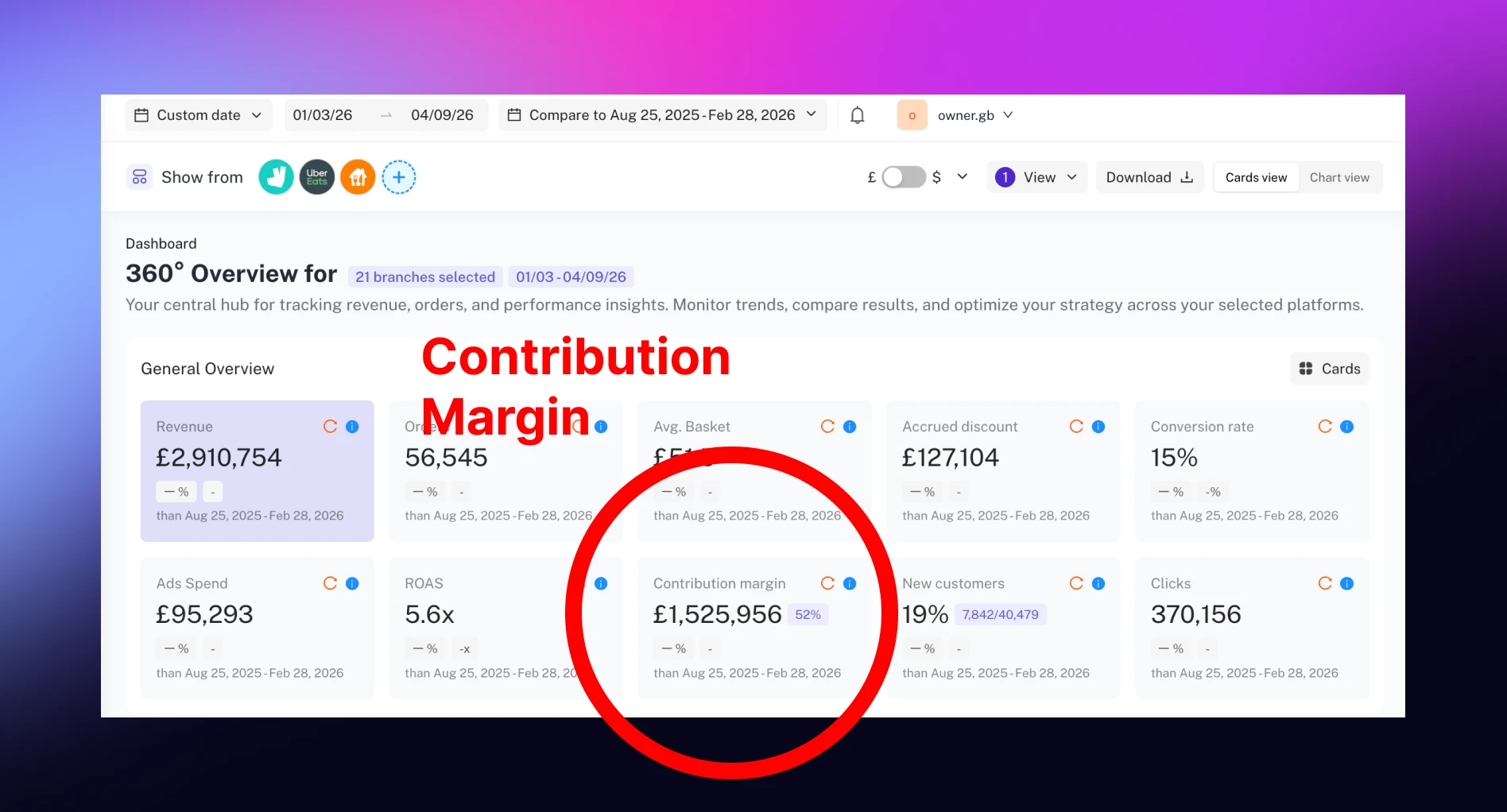
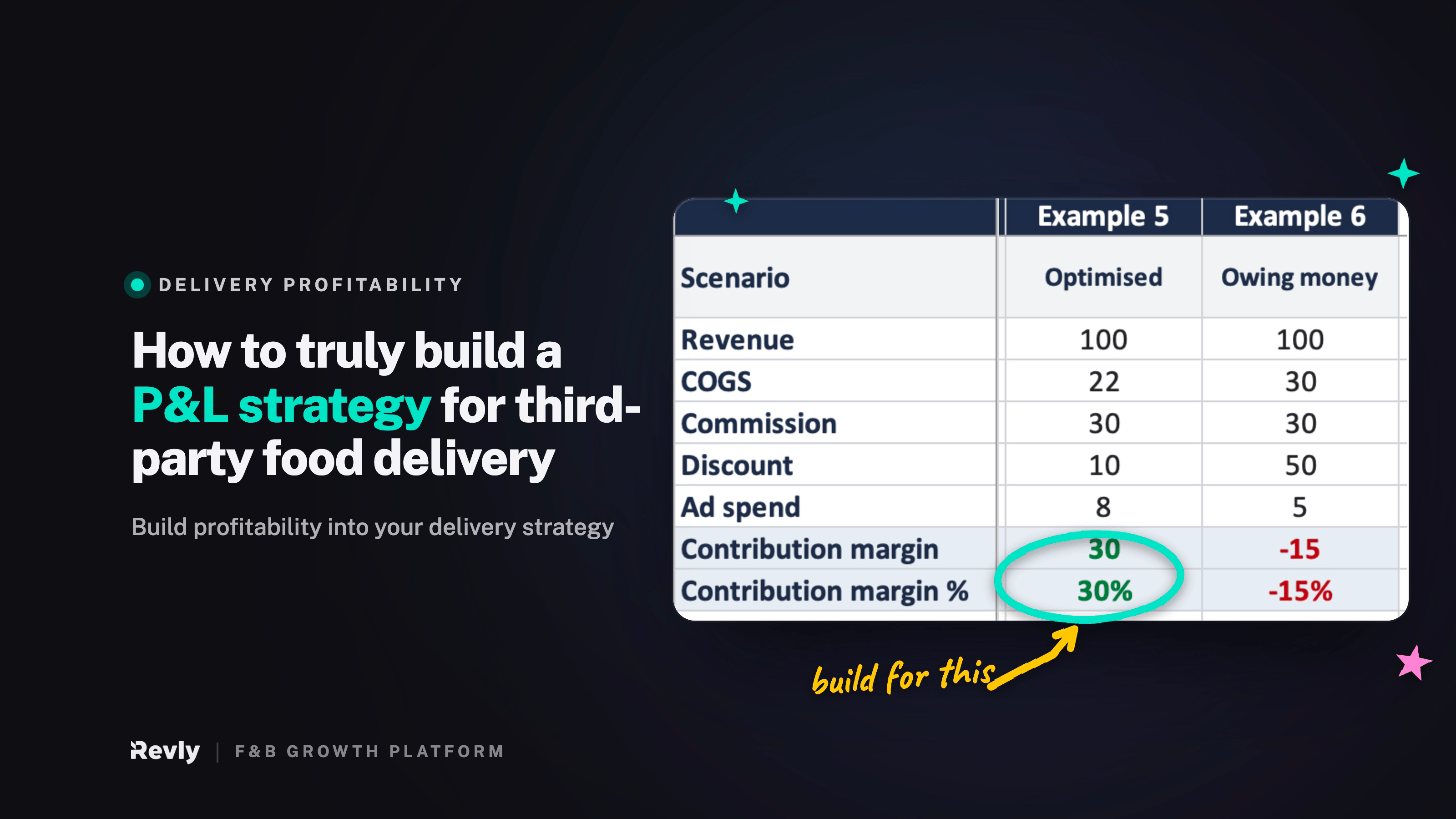
That number has a name, contribution margin, and it is what remains after commission, food cost, discounts and advertising are taken out.
It is also, almost everywhere, missing. Brands running thirteen or twenty-seven or thirty-five restaurants across three competing apps generally cannot see it per site. Head office looks at gross sales and the franchisee looks at his bank balance, which does not.
At Revly we help both franchisees and franchisors navigate the new delivery app marketing reality with automated software that can easily show marketing profitability, and make it available across multiple locations.
.webp)
.jpg)