
The 20 Talking Points About Food Delivery App Marketing That Help With Growth
Every week at Revly we have delivery app strategy calls with restaurant owners across the UAE, Saudi, Kuwait and Qatar going through their Talabat, Deliveroo, Noon, Careem and Keeta performance line by line.
After hundreds of these conversations, (over 500 in the last 6 months alone), many of the same talking points come up again and again. The platforms change, the menus change, the cuisines change, but the core challenges we help delivery operators solve are often quite similar.
Getting better performance on delivery apps is as much about asking the right questions, looking at the metrics that matter and having better conversations about how to take action.
As part of our mission to help food delivery operators grow on 3rd party delivery apps, we pulled the patterns out of those calls and tried to collect some of the key topics we regularly see.
This list will give you a flavor of how we work with restaurants but, if you are not a Revly client, our aim is to help you start asking the right questions when it comes to your delivery app operations.
Here are the 20 talking points worth knowing.
1. Conversion rate is the number everything else hangs on
Conversion rate is the share of people who view your menu and actually place an order. It comes up on every single call we run, because it is the cleanest signal of whether your listing is working.
Why it matters: A small move in conversion can mean a big move in revenue, with no extra ad spend. On one call we showed an owner that a conversion rate of 11% instead of 9% would have lifted revenue by 10 to 20% for the same traffic.
The benchmark we use: 12 to 15% is good. 16 to 20% and above is excellent. Most restaurants sit at 8 to 11% and do not realise it.
Key takeaway: Before you spend a dirham more on ads, find out what your conversion rate is and don't invest heavily in marketing until your conversion rate makes the numbers work. Our full guide on how to increase conversion rate on delivery apps walks through the fixes.
2. Scaling ads on a weak menu just burns money faster
The instinct when sales are slow is to push more ad spend. If your menu is not converting, that spend amplifies the leak instead of fixing it.
Example: One brand scaled ad spend and watched clicks rise while conversion dropped 2%. The problem was not the ads. It was pricing and out-of-stock items on the menu. More traffic to a broken funnel is just a more expensive broken funnel.
Key takeaway: Fix conversion first, scale ads second. Never the other way around. For more on judging ad efficiency, see our guide to ROAS and your restaurant.
3. Your menu photos are doing more selling than you think
We hold ad campaigns for new clients until their photos are done. That is how much images matter.
Why it matters: Delivery app users are comparison shoppers scrolling fast. Consistent, appetising images across every platform lift conversion even when the customer does not consciously notice them. One operator was sitting at a 12% menu-to-cart rate against a platform standard closer to 30%, and weak presentation was a big part of it.
Key takeaway: Running ads to a menu with bad photos is money wasted. Shoot first, spend second.
4. Keyword ads are the most underused growth lever
Keyword ads put you at the top when a customer searches a term like "coffee" or "biryani." They consistently outperform other ad types, and they are still underdeveloped on Noon while everyone fights over Talabat.
Example: One restaurant added keyword ads mid-week and watched conversion jump to 21%. Another saw 16% conversion on keyword ads versus 8% on premium positioning. A dessert brand picked up 24 orders in the first 14 days on Noon.
ROAS Impact: Keyword ads on Talabat can have a ROAS well over 10x - especially if you have higher brand equity.
Read our guide on running high performing keyword ads here: food delivery app search ads and keyword strategy.
Key takeaway: If you are not running keyword ads, you are leaving your cheapest growth on the table. Don't let the more complicated setup put you off. With the right strategy you can get a lot of extra orders with keyword ads.
5. Prune the keywords that spend but do not sell
Setting up keyword ads is not the end. The keywords need watching.
Example: One coffee brand was paying for the keyword "matcha," getting clicks, and getting no orders from it. We cut it, and the return on ad spend across the whole campaign improved.
Key takeaway: A keyword that spends without converting is dragging down your entire campaign. Review and trim regularly.
6. A 50% discount might attract exactly the wrong customer
Big headline discounts feel like growth. Often they just rent you customers who vanish the moment the offer ends.
Example: One outlet had a flat, uncapped 50% go live without our input. Our response was blunt: it was spoiling the positioning of the outlet. On another call we warned that 50% attracts discount hunters who never become regulars.
What we recommend instead: Item-level discounts on 3 to 5 items, capped at 25 to 30 AED, rather than a percentage off the whole menu. Our top 10 restaurant promotion ideas covers offers that pull the right customers.
Key takeaway: Discounts can build a brand when done well. Never write them off entirely. But they can also hollow out your brand if done the wrong way and lead to big problems in the long run.
7. Buy-one-get-one can be cheaper than a discount
This one surprises owners. For a lot of products, giving a second item away costs you less than taking a percentage off.
Example: A coffee owner ran the maths on his own call. A cup of matcha costs him three to four dirhams to make. The packaging is where the real cost sits. So a buy-one-get-one on matcha is more cost-friendly than a discount, because the expensive part is already paid for.
The catch: Buy-one-get-one floods your listing with traffic. If the offer covers too many items, it can crash your conversion rate. Keep the item list tight.
Key takeaway: Know where your cost actually sits before you choose your promo. Compare Offers on Revly lets you see what is working against your competitors.
8. New customers are easy. Repeat customers are the business.
Acquisition is the part most owners focus on. Retention is the part that decides whether you have a business or a treadmill.
Why it matters: The apps watch whether customers come back. A returning customer is cheaper for the platform than a paid click, so brands that retain get ranked higher. One brand was the number one new-customer brand in its area and still ranked 69% below competitors, because nobody reordered.
Key takeaway: If your new-versus-repeat split is all new, the algorithm will quietly stop pushing you. Learn what drives placement in our guide to ranking higher on UAE's food delivery apps.
9. Charging new and repeat customers the same price kills retention
If a first-time buyer and a loyal regular see the exact same offer, the first-timer has no reason to come back at the right moment.
Example: A cloud kitchen brand kept losing customers after one order. One cause was a single discount applied to everyone, with nothing to pull a new customer back for a second purchase.
Key takeaway: Separate your acquisition offer from your retention offer.
10. Your kitchen is your retention team
Sometimes the reason people do not reorder has nothing to do with marketing. It is on the plate.
Example: One operator had strong new-customer numbers and weak retention. The honest diagnosis was portion size and pricing, not the ads. As he put it, comparing his food to a big-brand rival: the rival's portions were huge and that perception of value won, even where his food was better.
Key takeaway: Perceived value drives reorders. Check it before you blame the marketing.
11. Offline time is bleeding revenue you already paid to earn
Every hour your store shows offline is an hour of visibility, and ad spend, thrown away.
Example: One multi-location brand had a single store log 19 hours offline in one week. The owner's frustration was that it came up every week and still happened. The fix was per-store logins so individual locations were accountable, and treating offline time as a KPI sitting right next to revenue.
Key takeaway: Track offline minutes per location every week. It drags your ranking, not just that day's orders. What we are seeing more and more is delivery apps using offline time as a key metric in their organic visibility algorithms. For example Deliveroo's value program. There is more on this in our guide to optimising your restaurant on Deliveroo.
12. You are silently losing 2 to 3% of revenue to order errors
Missing items, wrong dishes and quality complaints are not just bad reviews. They turn into platform deductions that come straight off your revenue.
Example: On one call we flagged that 2 to 3% of revenue was going to deductions and complaints. As we told the owner, at scale that is a very big number. Real review lines like "asked for Nihari but got another item" and "no salad, no raita, only tasteless chicken" are revenue leaks, not just feedback.
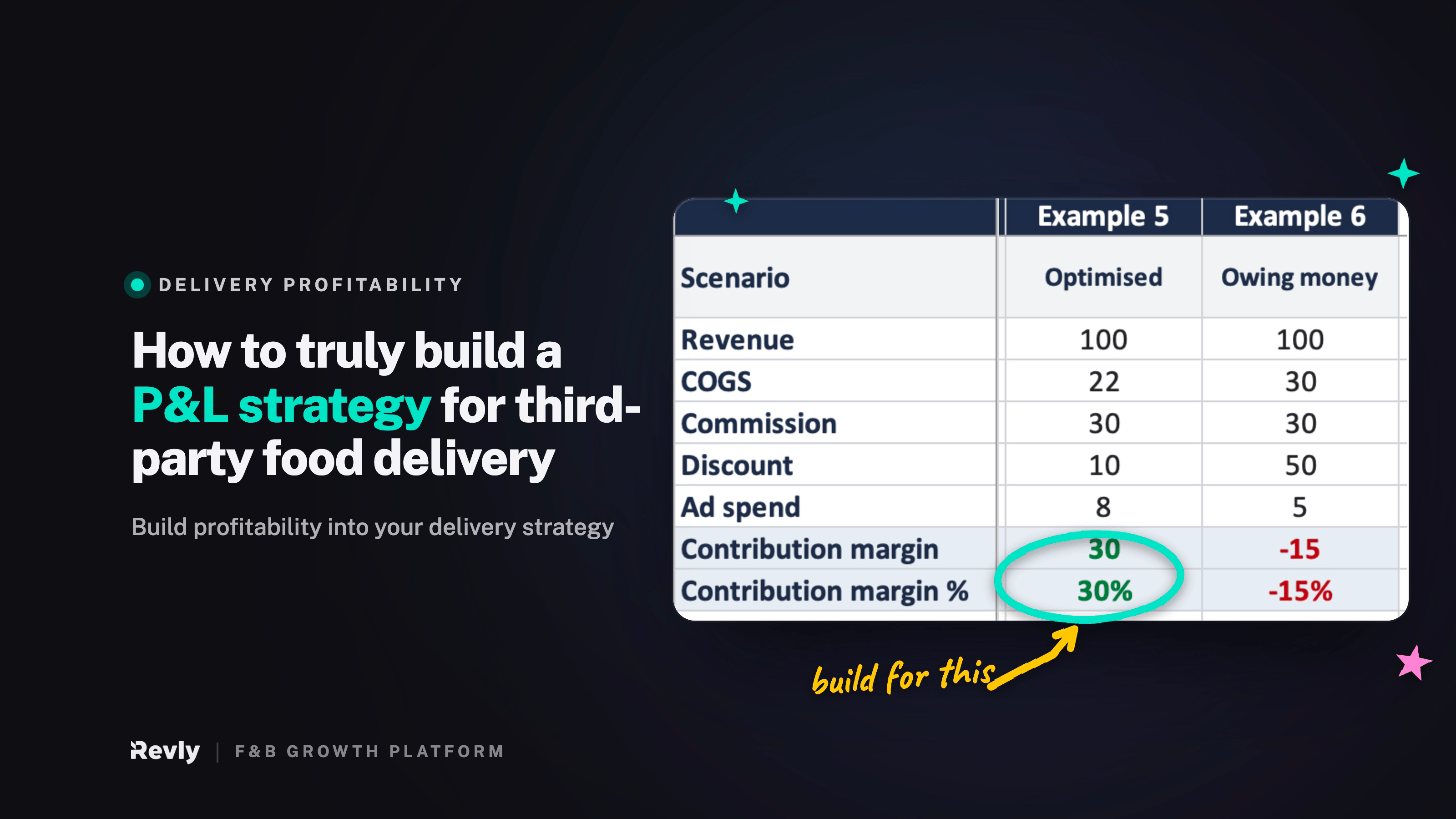
Key takeaway: Operational quality, reviews and ranking are the same problem wearing three hats. Use the platform dispute tools to claw deductions back. These leaks come straight off your contribution margin.
13. Reviews are the moat that decides if you are even visible
Review count is not vanity. It is what keeps a new listing buried or lifts an old one to the top.
Example: The same coffee brand ranks first for "coffee" in one neighbourhood with 500-plus reviews, and sits invisible in another with just 53. Same brand, same product, completely different visibility.
The trap: Reviews do not always transfer when you relaunch or migrate a listing. One brand had to fight to get theirs moved across, or they would have reset to zero.
Key takeaway: Protect your reviews like an asset, because that is what they are.
14. Raise prices in steps, not in one jump
Costs are climbing for everyone. The instinct is one big price rise. The smarter move is to creep.
Example: One owner wanted to raise prices 10% in one go. We moved them to 5% now and 5% the following month, specifically to test how customers responded and avoid a sudden drop in orders.
Key takeaway: Phase your increases and watch order volume after each step.
15. Create headroom before you discount
If you want to run generous-looking offers without destroying margin, build the room in first.
Example: One brand raised base prices around 10% on two platforms, then layered item-level discounts on top. The listing looked generous to customers while the margin stayed protected. Another nudged prices up 1 to 2 dirhams per item to recover margin without shocking long-term customers.
Key takeaway: A discount on top of a corrected base price looks bigger than it costs you.
16. A "dead" listing can be revived, and the jump is huge
There is a state worse than low sales: a listing the algorithm has stopped showing. Owners often blame the food when the listing itself has gone dark.
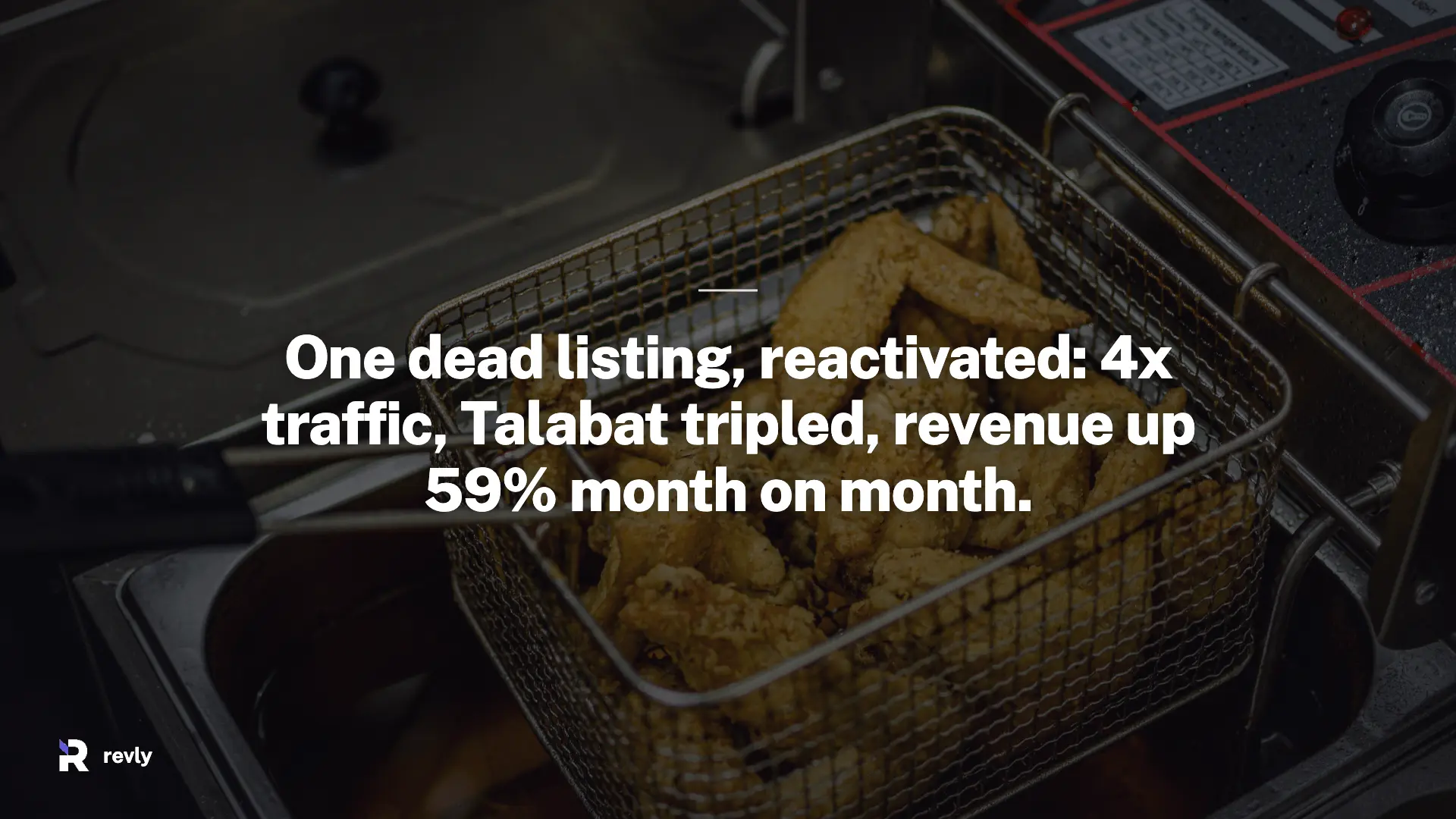
Example: One brand's listing was, in plain terms, dead. After reactivation it did 4x the traffic, and unlocked new customers across every platform. Month on month, Talabat tripled and overall revenue rose 59%. For a full turnaround story, see how Dolan Cafeteria grew revenue 158%.
Key takeaway: Learn the difference between "my food is not selling" and "nobody is being shown my food."
17. Do not treat every platform like the same shop
Most owners load one menu, one price list and one set of offers onto every app. The platforms do not share the same customers.
Example: One owner pushed back hard on a copy-paste approach, and he was right. In his experience Deliveroo skews premium while Noon and Careem skew everyday, and his pricing and offers reflected that per platform.
Key takeaway: Set platform-specific pricing, bestsellers and offers. Lazy copy-paste menus under-charge premium audiences and over-charge value ones. We break down each app in marketing on Talabat vs. Deliveroo vs. Careem vs. Noon.
18. Menu order is a sales decision, not housekeeping
What sits at the top of your menu, and what you bury, directly shapes what people buy.
Example: One brand pushed gift boxes to the top of the menu and watched everyday-product orders drop. Gifting buyers and everyday buyers are different people. The fix was simple: bestsellers and everyday items up top, occasion products at the bottom, plus a build-your-own box for customers who wanted to mix flavours.
Key takeaway: Put your everyday hero products where the eye lands first.
19. "Cleaner" is not a goal. Numbers are.
Menu revamps get sold on how tidy they look. Tidy does not pay rent.
Example: After one revamp, an owner watched orders fall and said it plainly: "I don't care about things looking cleaner. I care about my numbers going up." A redesign that looks better to you can confuse a customer who knew exactly what to tap before.
Key takeaway: Judge every menu change by what happens to orders in the two weeks after, not by how clean it looks. Our practical guide to comparing marketing performance shows how to tell good from bad.
20. Ride the calendar with naming, not new products
Big cultural moments are a sales opportunity, and you do not need a new menu to use them.
Example: For the World Cup, one chain renamed existing items rather than building anything new: World Cup Nuggets, Argentina Glory boxes, and rolls named Messi Roll, Golden Boot Roll, Hat-trick Roll and Final Whistle Roll. Same food but with themed naming often means more taps. Ramadan, Eid, summer and back-to-school all work the same way.
Key takeaway: Theme what you already sell. It lifts orders without touching your kitchen or your cost. Pair it with optimising your ads for peak meal periods to catch the demand when it spikes.
Key Takeaways
- Conversion first. It is the number everything else depends on, and most brands underrate it.
- Discounts are a scalpel, not a hammer. Item-level and capped beats big headline percentages.
- Retention is ranking. The apps push brands whose customers come back, so fix the reasons they do not.
- Operations are marketing. Offline time, order errors and reviews all feed visibility and revenue.
- Treat each platform on its own terms. Different audiences, different pricing, different offers.
These talking points come from real conversations with real operators, week after week. The restaurants that grow are the ones that treat this as a system, not a guessing game.
Turn on your food delivery growth engine today. Book a free demo.
Related reading: How Much Should You Really Be Spending on Food Delivery App Marketing? and Should Your Restaurant Launch on Food Delivery Aggregators?.
.jpg)
%20(1).jpg)